
Nail salons we insure
Nail Salon Insurance
One program for a salon with staff and a lease: who pays when a customer is hurt, when the salon is damaged, when a technician is injured, and what the landlord needs to see.
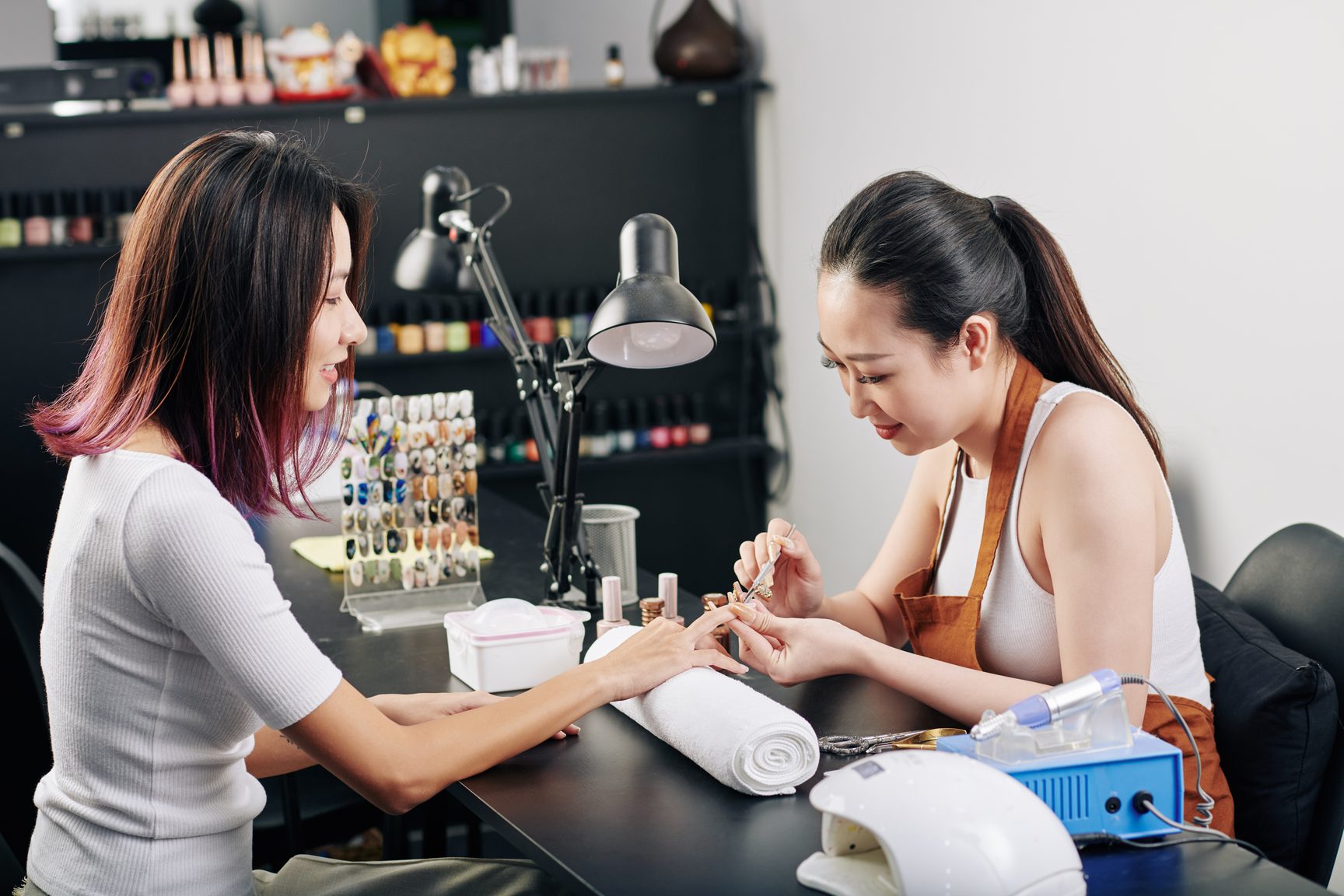
Nail salon insurance, which owners also call nail salon business insurance, is the group of policies an owner carries so that every way a salon can lose money has somewhere to go: a customer hurt during a pedicure, a fire that ruins the stations, a technician injured on the job, a car accident on the way to the supply store. For a salon with employees in a leased storefront, the core is general liability and property, with workers’ compensation for the payroll and commercial auto and an umbrella added when the business calls for them.
This page treats the salon as one business rather than as a stack of separate purchases. It sets out what each policy is there to answer, walks through an ordinary day to show where claims start, and covers the lease, the people who work in the salon and how we put a quote together. Each policy has its own page that goes into the detail; here the point is how the pieces fit, and what falls through if one of them is missing.
The salon this page is written for
We write for the owner of a nail salon that offers manicures, pedicures and the spa services that go with them, from a rented unit in a strip center, a shopping plaza, a downtown block or a mall. The owner has technicians on the payroll, a front desk that books appointments and takes walk-ins, a lease that someone else drafted, and equipment and stock bought with the business’s own money. That might be a single shop or a small group of locations under the same name.
That owner is the person who signs the lease and the insurance application, hires the technicians and answers to the landlord, so that is whose program this page describes. A nail technician who rents a booth or a suite inside somebody else’s salon is in a different position: the technician runs a separate small business and buys coverage in their own name, which our guide to whether nail technicians need insurance covers from the technician’s side. If you own the salon and rent booths to others, the section on employees and booth renters below is for you, and our guide to hiring employees or renting booths sets the two side by side.
A comparison sorted into groups. Under other people: a customer who slips by a footbath, and a visitor’s coat stained by remover; both go to general liability, with an umbrella above its limit. Under the salon’s own things: chairs and lamps ruined by a burst pipe go to property, and the weeks the doors stay shut go to business income written with property. Under the salon’s own people: a technician’s cut or rash goes to workers’ compensation. On the road: a crash on a supply run goes to commercial auto, whether or not the salon owns the car. Your own policy wording decides any real claim. No figures are shown.
The policies in a nail salon program and where each one stops
Each policy below answers a different question about a loss: who was harmed, what was damaged, and whether a vehicle or a bigger claim is involved. The paragraph for each says what it is for and where it hands off to another; the linked page goes through the policy itself. Your own policy wording governs any real claim.
Other people and their belongings
General liability is the policy for anyone who is not on your payroll: the customer at the station, the parent waiting in the chairs by the window, the courier at the counter. It answers for their injuries and for damage to their things when the salon or its work is the cause, and it pays for your defense. Nail salon liability insurance is also the line a landlord names in the lease, so it is the policy a lease asks about first. It stops at your own equipment, your own staff and anything on wheels.
The salon’s own equipment, build-out and income
Property coverage takes over where general liability stops: the salon’s own chairs, tables, lamps, drills, furniture, computers and stock, along with the improvements you paid to install in a space you lease. When a fire, a burst supply line or a break-in shuts the doors, the business income part of the program is what keeps payroll and rent moving while the salon is put back together. It does not answer for a customer’s injury, even when the same event causes both.
The technicians and staff
Workers’ compensation is for the people you employ. An injury or illness that comes from the work goes here rather than to general liability, and the employer’s liability part of the policy stands behind you if an injured employee’s claim turns into a lawsuit. Its premium follows payroll, which is why the way your technicians are paid matters to it as much as how many there are.
Vehicles used for the business
Commercial auto belongs in the program only when the salon puts a vehicle on the road: a car or van titled to the business, an employee who drives a personal car on salon errands, or a mobile service that travels to clients. If none of that describes your salon, you can leave it out. If any of it does, a personal auto policy is not a substitute.
A higher ceiling over the liability policies
An umbrella sits on top of general liability, commercial auto and employer’s liability and adds to their limits once a claim exhausts them. It does not fill a gap where an underlying policy is missing or excludes the claim, so it only works once the policies beneath it are in place. Owners look at it when a lease asks for more liability than the primary policy carries, or when the business has grown beyond what that policy alone protects.
A flow that follows a salon’s day. Opening up, where a walk-in can trip on a bunched mat, reaches general liability. The pedicure stations, where water, heat and moving chairs meet bare feet, reach general liability for customers and property for the chairs. Working with products reaches workers’ compensation for technicians and general liability for customers. Cleaning between customers produces the record that answers an infection claim. The retail counter reaches the products part of general liability. Closing up, when fire and theft after hours become possible, reaches property. The supply run reaches commercial auto. Your own policy wording decides any real claim. No figures are shown.
A salon’s day, from unlocking the door to the evening supply run
Claims in a nail salon come out of ordinary work. Following a single day shows where they start and which policy each one reaches.
Opening up
Before the first appointment, someone unlocks, turns on the lights, the ventilation and the towel warmers, sets out tools and checks the floor. A mat bunched at the threshold after a wet night, a sign leaning in a doorway or a cord stretched across a walkway to an outlet are the first hazards of the day. The early walk-in who trips on one of them is a general liability question; the sign itself, if wind takes it into the glass, is a property one.
The pedicure stations
The pedicure area brings together water, heat, electricity and bare feet. Basins are filled and drained between customers, chairs rise and recline, and people stand up after soaking with soft skin and painted toes. A slip on the platform step, a pinch from a moving chair and a basin left warmer than a customer can bear are injuries to someone who is not on your payroll. A failed fitting that floods the floor and damages the chairs and the shop below is a different loss, split between your property policy and, for the shop below, your liability policy.
Working with products
Monomer, powder, gel, polish, remover and disinfectant are poured, mixed and wiped up at the stations all day. The CDC’s workplace page on nail technicians describes how workers can breathe in dusts and vapors or absorb chemicals through the skin, and that is the side of the exposure that falls on workers’ compensation. A customer who blames a product for a reaction, or a business sharing your wall that complains about the smell, brings the liability policy in. How each policy treats chemicals depends on its wording, which is one of the reasons we read the exclusions before we recommend anything.
Between customers
Every station is cleaned and the tools disinfected or sterilized before the following customer sits down, following the rules of the state where you are licensed. Write each cleaning down. A customer who reports an infection weeks after a visit is making a bodily injury claim, and the cleaning record for that basin and those tools is the evidence that answers it. The autoclave or sterilizer itself is equipment; if it fails or shorts out, it is a property question.
The retail counter
Cuticle oil, hand cream, polish and tools sold at the front desk go home with customers, and a product that injures someone after the sale is still tied to your salon. The products and completed work part of general liability is where that claim is read, and a line sold under your salon’s own label is worth mentioning when we quote. The stock on the shelf, before anyone buys it, is property.
Closing up
At the end of the day the stations are wiped down, lamps and warmers are switched off, product containers are capped and the cash drawer is counted. A loss an owner finds the following morning can start here: a warmer left plugged in, a rag soaked in remover left in an open bin, a back door left unlocked. Fire, theft and vandalism after hours belong to property coverage, along with the income lost while the salon is closed for repairs.
Deliveries and the supply run
Couriers bring boxes to the front desk, and some days the owner or a technician drives to a supplier to restock. The courier who slips on a freshly mopped floor is a general liability claim. The drive is not: a collision in a salon-owned car, or in an employee’s own car on a salon errand, is the case for commercial auto, including its hired and non-owned coverage when the salon owns no vehicle at all.
Your lease and what it asks of your insurance
A commercial lease has an insurance section, and it is written for the landlord. Read it before you sign, and send it to us at the same time, because each of its requests has to be matched by something in your policies.
A certificate of insurance. The landlord wants proof that the coverage the lease requires is in force, and a certificate is that proof. It summarizes policies; it does not change them, so if the policies fall short of the lease, the certificate will show it.
Additional insured status. The lease may require that the landlord, and sometimes the property manager, be added as additional insureds on your general liability policy, so that your policy responds when a claim arising from your space names them too. That takes an endorsement, and its wording has to match what the lease asks for.
A waiver of subrogation. After paying a claim, an insurer can ordinarily try to recover what it paid from whoever caused the loss. A lease may ask each side to waive that right against the other, so your insurer cannot pursue the landlord after a covered loss, and the landlord’s insurer cannot pursue you. Your policies have to allow the waiver, which can take an endorsement of its own.
Tenant improvements. Plumbing for pedicure chairs, electrical work for lamps and drills, the ventilation, floor finishes and cabinetry you paid for inside the unit are your improvements, and the lease decides who must insure them and who must rebuild them after a loss. Ventilation can be a legal requirement as well as a comfort. New York’s Department of State, for example, tells salon owners on its nail salon information page that businesses offering nail services are to provide ventilation that captures and exhausts fumes and particles away from clients and workers. Equipment installed to meet a rule like that is part of your build-out, and it belongs on the property policy at the value it would take to replace it.
Employees, booth renters and the people in between
Who counts as your employee drives two parts of the program at once. Employees belong on your workers’ compensation policy and in its payroll, and their work is covered by your general liability as part of the salon’s operations. A booth renter or an independent technician is different: that person runs their own business in your space and should carry their own liability policy, and may need their own workers’ compensation if they employ anyone.
The label on the agreement is not the only thing that decides which side of the line someone falls on. States look at how the work is arranged, such as who sets the schedule, who supplies the products and who books the customer, and they do not all draw the line in the same place. A salon that treats someone as a renter when the state treats them as an employee can find that person’s injury, and their payroll, on its own policy after the fact. The safe course is to describe every arrangement to us accurately, to keep a signed agreement and a current certificate for each renter, and to read the rules where you operate. Our state pages will set those rules out state by state.
When the service travels to the client
Some salons send technicians to clients’ homes, wedding parties, care facilities and corporate events, and some owners run a mobile service alongside the shop. The exposure travels with the technician: a client hurt during the service is still a general liability question, and the drive there and back is a commercial auto one. Kits and portable equipment that leave the building should be described when we quote, because a policy written around a fixed address may treat them differently once they are on the road.
How we quote nail salon business insurance
We are an independent agency with appointments at 23 insurance markets, and each one looks at nail salons in its own way. Some want a single storefront with a short list of services; others are comfortable with larger salons, several locations or mobile work. Our job is to describe your salon accurately and send it to the markets that want it. To do that we ask for:
- the services you offer, including any spa services and artificial nail work;
- the number of stations and chairs, and who works at them: employees, booth renters or both;
- your payroll, and how technicians are paid;
- the address, the lease’s insurance section and whether you own or rent the building;
- the equipment, furniture and stock you keep, and what you spent on the build-out;
- any vehicle used for the business, and any work done away from the salon;
- products sold at the counter, including any under your own label;
- your current policies and their claims history.
Each of those answers moves the price, which is why we do not publish one. A complete submission is the fastest one: when we have the lease section, the payroll and the current policies at the start, we can send the account out without a second round of questions and come back to you as soon as the markets answer. Before you see a quote, we compare the policies against your lease and against each other, so the handoffs this page describes hold up on paper too.
States where we insure nail salons
We place nail salon insurance in 48 states, every state except Alaska and Hawaii. The FDA’s page on nail care products notes that state and local authorities regulate the operation of nail salons and the licensing of the people who work in them, and those rules change what a salon must do day to day. Workers’ compensation rules, the treatment of booth renters and the requirements a landlord can impose differ as well. State pages are being published in the order of the search demand we measure from salon owners: Michigan, Massachusetts, California, Florida, New York, Texas, Illinois, Georgia, Rhode Island, Maryland, New Hampshire and Pennsylvania. The full list is on our states we serve page.
Why Protect My Nail Salon
Protect My Nail Salon insures one kind of business, the nail salon, so a salon’s quote is read against other salon quotes rather than against a general small-business form. The first things we check are the ones that decide whether the program works: how the liability policy treats an injury from the service itself, whether the property limit matches what is in the unit, how the people at the stations are classified, and whether the policies meet the insurance section of the lease.
We place coverage with 23 insurance markets in 48 states, and a licensed agent reads every request. Every coverage on one page sets the five policies side by side, and our guides for salon owners take single questions further, filed under cost guides, coverage explained and owner resources. A good first read is our guide to nail salon insurance requirements, because the state, the lease and your own payroll each add something you must carry.
For a closer look, read our guide to what nail spa insurance costs, which explains how added spa services change the price of the program. We also have a guide to what a nail bar’s insurance costs, which prices a walk-in nail bar policy by policy.
Each policy in detail, and our sources
Coverage for your salon
Questions owners ask about insuring a nail salon
Who decides what coverage my new salon has to carry?
The answer comes from more than one direction. Your state sets the rules for employers, including workers’ compensation once you have employees, and licenses the salon and the technicians. The lease sets its own insurance terms, and a lender, an equipment finance company or a franchise agreement can add more. We gather all of them before we quote, so the program meets every requirement on the day it starts.
Do the coverages for my salon come as one package or several?
Several, though they can arrive in fewer documents than you expect. Some markets package general liability and property together in a business owner’s policy, and others write them separately. Workers’ compensation, commercial auto and an umbrella are written as their own policies. What matters is that each piece knows about the others, so a claim does not land in a gap between them.
When should I buy insurance if I am opening a new salon?
Before you sign the lease, at least as a quote, because the lease will name what you must carry. Property should be in force before chairs, lamps and stock are delivered to the space, liability before the first customer walks in, and workers’ compensation before your first employee starts. Starting early also gives us time to place the account with a market that wants it.
I am buying an existing nail salon. Does the seller’s insurance come with it?
Generally not. The seller’s policies belong to the seller’s business and end with the sale, so you need your own program in force on the day you take over. Ask the seller for the salon’s claims history and a copy of the lease’s insurance section, because both shape how underwriters will view the salon under its new owner.
Do booth renters in my salon need their own insurance?
A technician who rents a booth runs a separate business inside your space, so the technician’s own liability policy is the one that should answer for that technician’s work. An owner can write that requirement into the booth rental agreement and ask for a certificate each year. How your state treats the arrangement for employment purposes is a separate question, and one we work through with you.
Can I insure a second salon location on the same program?
Generally, yes. Each location is listed on the policies with its own address, equipment and lease terms, and the liability and property limits are set with both in mind. A second location in another state adds that state’s workers’ compensation rules, so tell us where it is before you sign that lease too.
Can I move my coverage to a new company before the renewal date?
You can, but time it carefully. The new policies should start on the day the old ones are canceled, with no gap between them, and the canceled policy may return less unearned premium than you expect. Renewal is the cleaner point to move, and we can begin the quote well before that date.
Put your whole salon in front of a licensed agent
Send the lease’s insurance section, your payroll and your current policies. We read them together and come back with a program built around how your salon runs.