
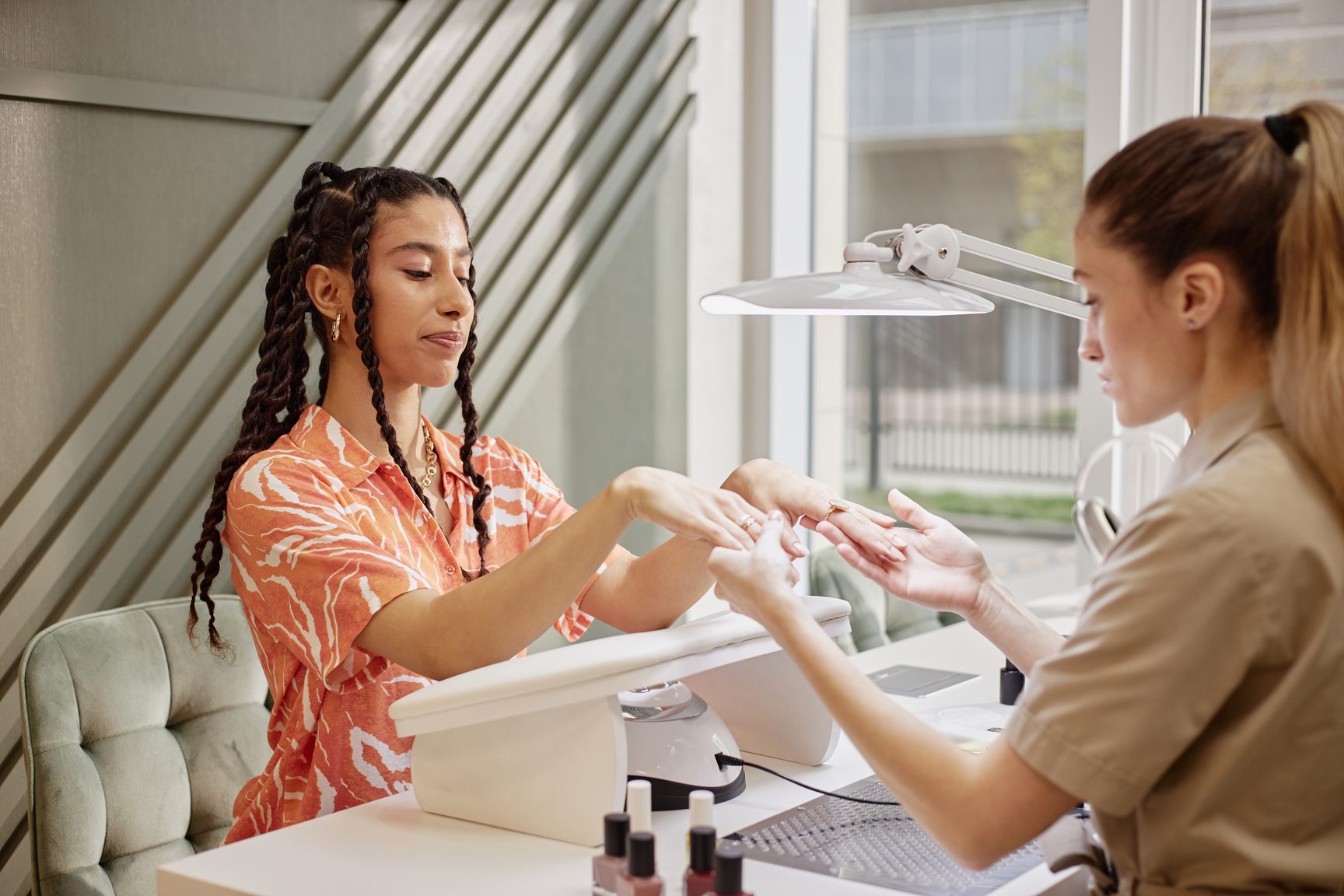
A nail studio built around gel and acrylic work uses monomers and polymers, gel polishes, primers, curing lamps, electric files and the solvents that remove them. Those products are what clients come for, and they are also the facts an insurer weighs on every policy in the program. This guide explains how fumes, chemicals and client reactions shape a gel and acrylic studio’s insurance, and what to ask before you rely on a policy.
We do not give chemical safety advice; your product manufacturers and your state board do. What follows is how those risks reach your policies.
The products, as an insurer sees them
The FDA’s page on nail care products says that infections and allergic reactions can occur with some nail products, and that state and local authorities regulate the operation of nail salons. NIOSH’s page on nail technicians lists common chemicals in nail products, including acetone, and notes that workers can breathe in dusts or vapors from them, absorb them through the skin or ingest them.
Each of those facts lands on a different policy. A client’s reaction is a liability question. A technician’s exposure is a workers’ compensation question. Products stored near heat are a property question. And a claim that the service itself was done wrongly can be a professional liability question.
General liability: reactions, burns and cuts
General liability answers a client’s injury, and a gel and acrylic studio has specific ones: an allergic reaction to a monomer or a gel, a burn from a curing lamp, a cut or heat injury from an electric file, an infection after the natural nail is damaged. These are the claims the policy has to be written to answer.
Two questions decide whether it fits:
- Does the policy describe your services exactly? A description that says manicures and pedicures but leaves out acrylic sculpting, gel extensions or e-file work invites a dispute after a claim. List every service and every tool.
- How does the policy treat pollution? Liability policies can carry pollution exclusions. How one applies to fumes inside a salon depends on its wording, so ask your agent to read it against your services before you rely on it.
A claim that the application itself was done wrongly, such as damage to the natural nail from improper removal, can sit outside a plain general liability form. Some programs carry a professional liability endorsement. Our guide to professional liability for nail salons explains it.
Real-World Scenario: A client returns a week after a set of acrylic extensions with red, swollen fingertips and a doctor’s note describing a reaction to the monomer. She asks the studio to pay her medical bills. The claim goes to the studio’s liability policy, and the first thing the carrier reads is the description of operations. A description that named acrylic work, and records showing the product was used as directed, put the studio in a far better position.
Workers’ compensation: what your staff breathe and touch
Your technicians work with these products all day. Workers’ compensation is the policy for an employee’s work-related injury or illness, from a chemical burn to a skin condition or a breathing problem the employee traces to the work. Whether the coverage is required depends on your state; our guides read the rules for New York and California, among others. The workers’ compensation page explains the policy.
Tell your agent what products your staff use and what ventilation the studio has. New York, for example, requires nail businesses to provide ventilation that captures and exhausts contaminants and fumes; your own state board may set its own rules.
Property: storage, heat and equipment
Business personal property insures your lamps, files, sterilizers, ventilation equipment, stock and improvements. A fire is the loss the policy exists to answer, and an underwriter may ask how products are stored and how much sits near heat or equipment. Describe your storage honestly so the application matches the studio.
Curing lamps and electric files are also equipment that breaks. Ask whether equipment breakdown is covered or offered as an addition.
Records that help after a claim
A studio that keeps records is in a stronger position when a claim arrives. Keep the product safety documents your suppliers provide, a record of your ventilation and how it is maintained, client intake notes that ask about known allergies, and notes of any reaction you observed and how you handled it. None of these is an insurance requirement on its own, but each helps answer the questions a carrier asks.
Young clients and gel or acrylic work
A studio that serves children faces extra questions about products and supervision. Our guide to kids’ nail salon and party studio insurance covers them.
Services that raise the underwriter’s questions
A gel and acrylic studio offers services that a basic salon may not, and each one gives the underwriter something specific to ask about. Expect questions on the following, and have the answers ready.
Acrylic sculpting and extensions. The monomer and polymer system, how the product is applied and removed, and how the work area is ventilated.
Hard gel and builder gel. The curing lamps used, how they are maintained and whether the gel is cured to the manufacturer’s directions.
Electric file work. Who uses the drill, what training they have and whether the tools are made for natural nails.
Removal and soak-off. The solvents used, how they are stored and how the client’s skin is protected.
Nail art with added products. Embellishments, adhesives and specialty products each add a question about reactions.
None of these is a reason to avoid the work. They are the reason the description on the policy has to be exact. An underwriter who knows what you do can write a policy that answers for it; an underwriter who learns about it after a claim reads the policy you have.
Training and supervision as an underwriting fact
A carrier weighs how a studio runs as well as what it offers. A studio where every technician holds the state license, follows the manufacturer’s directions, keeps a clean and ventilated station and documents client intake presents a more favorable picture than one that does not. That picture can affect what the carrier will offer and on what terms.
Keep each technician’s license on file. Keep any product training records your suppliers offer. If you bring in a new product line, read its safety documents before it reaches a client, and tell the agent if it changes what you do. A studio that treats its own safety practice as part of its insurance file is a studio that is easier to insure and easier to defend.
Clients with known allergies
Ask every new client about known allergies to nail products, adhesives or latex, and record the answer. If a client reports a reaction to a past service, decide before you begin whether to proceed and with which products. If a client reacts during a service, stop, record what was used and what you saw, and give the client the product information. Those notes protect the client first and the studio second.
Ventilation as part of the insurance file
Ventilation is a safety practice before it is an insurance fact, and it is both. Record what system the studio uses, when it was installed and how it is maintained, and keep the service records. If your state board or your city sets ventilation rules for nail work, keep a note of how you meet them. An underwriter may ask about ventilation for an acrylic-heavy studio, and an employee’s claim that a breathing problem came from the work will turn on the same facts.
Equipment breakdown in a lamp-heavy studio
A studio that depends on curing lamps and electric files depends on equipment that fails. A lamp that stops working mid-service is an inconvenience; a power surge that takes out every lamp and file in the studio is a closure. Ask whether equipment breakdown coverage is offered, what it covers and whether lost income from a breakdown is included.
How to get a quote for a gel and acrylic studio
Send us the address, the full service menu with the products and tools you use, the people who work in the studio and how each is paid, your ventilation setup, a list of equipment and improvements, the lease’s insurance section and your claim history. We will read the liability policy’s product and pollution terms against your services and quote the program together. The nail salon insurance hub lays out the five coverages, and the quote page is where to start.